Radon in Utah: What Every Homeowner Should Know
Table of Contents
Why Is Radon in Utah a Concern for Homeowners?
Radon is a naturally occurring radioactive gas that forms as uranium breaks down in soil and rock. Because Utah has geological conditions that can contribute to elevated radon levels, homeowners throughout the state should be aware of the potential for radon to enter their homes.
Radon is invisible, odorless, and tasteless, so the only way to know how much radon is in your home is to test. Elevated levels can occur in new and older homes, with or without basements, and even in homes located next door to properties with low radon readings.
At Total Radon Solutions, we believe understanding radon is the first step toward making informed decisions. That’s why we offer free radon testing throughout Utah, helping homeowners learn their radon levels without pressure or obligation.
Why Can Radon Levels Be Different in Neighboring Homes?
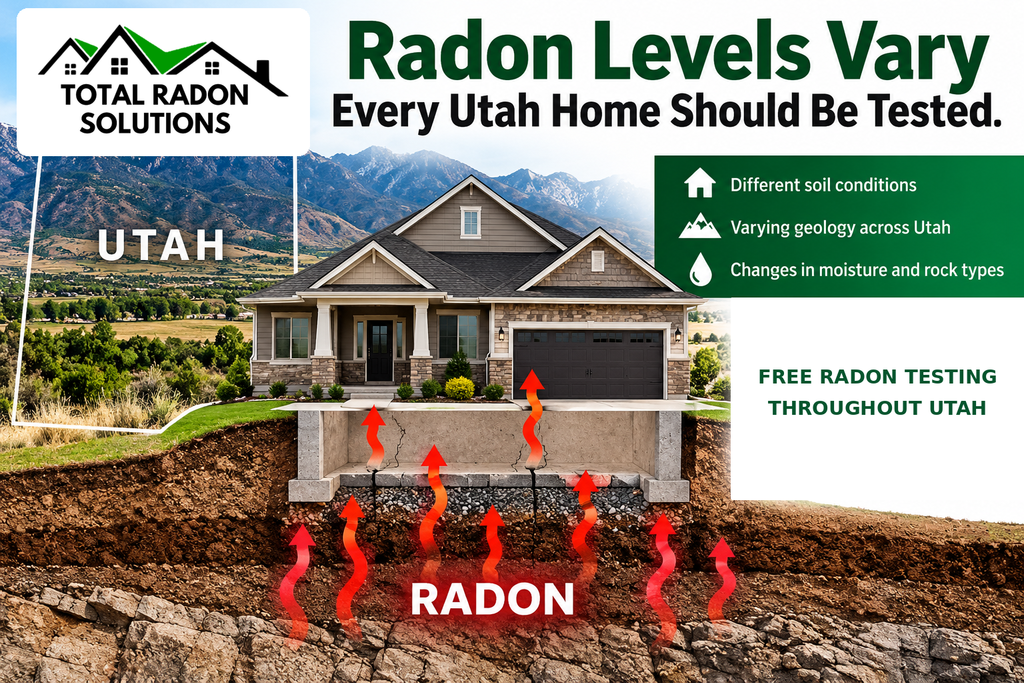
One of the most common misconceptions about radon is that homes in the same neighborhood will have similar radon levels. In reality, two houses sitting side by side can have dramatically different radon concentrations.
Radon levels depend on several factors, including the soil and rock beneath a home, the home’s foundation, how air moves through the building, and the pathways that allow soil gases to enter. Even small differences in construction or underground conditions can produce significantly different test results.
For example, one Utah homeowner might test below 2.0 pCi/L while a neighbor across the street measures above the EPA’s action level of 4.0 pCi/L. Neither result reliably predicts the radon concentration in the other home.
This is why testing your own home is so important. A neighbor’s low radon reading doesn’t guarantee your home is safe, and a neighbor’s high reading doesn’t necessarily mean your home has elevated radon.
How Does Utah’s Geology Affect Radon Levels?
Utah’s diverse geology plays an important role in radon exposure. The state contains many different types of rock and soil, some of which contain naturally occurring uranium. As uranium breaks down over time, radon gas is produced and can move through the ground toward the surface.
The amount of radon that reaches a home depends on more than just the uranium content of the surrounding rock. Soil permeability, underground moisture, geological formations, and the construction of the home all influence how easily radon can enter and accumulate indoors.
In some areas, porous gravel and sandy soils allow soil gases to move relatively easily. In other locations, fractures in rock or openings around foundations can provide pathways for radon to enter. Even areas with dense clay soils can experience elevated radon levels when conditions allow the gas to reach the building.
Because Utah’s geological conditions vary considerably, no city, county, or neighborhood can be assumed to have uniformly low radon levels. Geological maps can help identify areas with greater radon potential, but they cannot replace testing an individual home.
Where in Utah Are Elevated Radon Levels Found?
Elevated radon levels have been found throughout Utah, from the Wasatch Front and northern valleys to central and southern Utah. While some regions have a greater potential for elevated radon, no community should be considered automatically safe based on its location alone.
Central Utah — Sanpete, Juab, and Sevier Counties: Communities such as Ephraim, Manti, Mount Pleasant, Nephi, Richfield, and Salina have homes where elevated radon levels are a concern. Soil conditions, geological formations, and individual home construction can all influence indoor radon concentrations. Testing is the only reliable way to determine the level in a particular home.
The Wasatch Front and Utah County: Homeowners in Provo, Orem, Spanish Fork, Lehi, Salt Lake City, Ogden, and surrounding communities should also be aware of radon. Utah’s population centers include a wide variety of geological conditions, and radon concentrations can differ substantially between nearby properties.
Southern, Eastern, and Northern Utah: Radon testing is equally important in communities such as St. George, Cedar City, Price, Vernal, and Logan. Although regional geology and typical test results vary, elevated indoor radon levels are possible in every part of the state. A home’s location or the radon reading from a neighboring property cannot replace an individual radon test.
For additional information about radon in Utah, homeowners can visit the Utah Department of Environmental Quality’s Radon Program.
When Should You Test Your Utah Home for Radon?
Every Utah homeowner should test their home for radon, regardless of the home’s age, location, or construction type. Because radon is invisible and odorless, testing is the only reliable way to determine whether elevated concentrations are present.
Radon testing is particularly important when purchasing a home, after major renovations or foundation changes, or when finishing a basement that will be used as living space. Homeowners should also periodically retest because radon concentrations can change over time. The EPA recommends testing at least every two years, even when previous results were low.
At Total Radon Solutions, we make radon testing simple and accessible. For homes within approximately 75 miles of our Ephraim office, we generally use professional continuous radon monitors that record radon concentrations throughout the testing period. For homeowners farther away, we provide free mailed charcoal test kits with instructions for completing the test.
Our goal is to help Utah families understand their home’s radon levels without unnecessary expense or pressure. If testing identifies elevated radon concentrations, we’ll explain the results, discuss appropriate next steps, and provide a free mitigation estimate when requested. There’s never an obligation to purchase a mitigation system.
What Should You Do if Your Utah Home Has Elevated Radon Levels?
Finding elevated radon levels in your home doesn’t mean you need to panic, but it does mean you should take the results seriously. Radon is a long-term health concern, and the appropriate response depends on the measured concentration and the type of test performed.
The Environmental Protection Agency (EPA) recommends taking action to reduce indoor radon levels when testing confirms concentrations of 4.0 picocuries per liter (pCi/L) or higher. Homeowners should also consider reducing radon levels between 2.0 and 4.0 pCi/L, since no level of radon exposure is considered completely risk-free.
If an initial short-term test shows elevated radon, a follow-up test may be appropriate to confirm the results. Depending on the circumstances, this may involve another short-term test or a longer-term measurement. Very high readings should be addressed promptly rather than delaying action for extended testing.
When mitigation is appropriate, a professionally installed radon reduction system can significantly lower indoor radon concentrations. Most residential systems use a method called sub-slab depressurization, which draws radon-containing soil gases from beneath the foundation and safely vents them outdoors before they enter the living space.
At Total Radon Solutions, we help homeowners understand their test results and evaluate their options. We explain our recommendations, provide free mitigation estimates, and encourage homeowners to make informed decisions without high-pressure sales tactics. Our goal is to find an effective solution that fits the home while keeping the installation as clean and unobtrusive as practical.
Free Radon Testing Throughout Utah
Whether you live along the Wasatch Front, in central Utah, or in one of the state’s rural communities, understanding your home’s radon level is an important step toward protecting your family. Every home is different, and testing is the only reliable way to know whether radon concentrations are elevated.
Total Radon Solutions is based in Ephraim, Utah, and provides free radon testing throughout the state. We use professional continuous radon monitors for most homes within approximately 75 miles of our office and provide free mailed charcoal test kits for homeowners farther away.
If your test results indicate elevated radon levels, we’ll help you understand what the numbers mean, explain your mitigation options, and provide a free estimate when appropriate. We believe homeowners deserve accurate information, quality workmanship, and the freedom to make their own decisions without sales pressure.