
How Does Radon Exposure Affect Your Health?
Understanding radon health risks begins with an important distinction: radon is a radioactive gas, but much of the danger to our lungs comes from the radioactive solid particles produced when that gas breaks down.
Radon occurs naturally in soil and rock and can enter homes through openings in foundations and other pathways. Because it is colorless, odorless, and tasteless, elevated levels can go undetected for years.
Although most inhaled radon gas is exhaled, its radioactive decay products can become deposited in the lungs, where they release radiation capable of damaging living cells. Over time, this exposure increases the risk of lung cancer.
The level of risk depends on the radon concentration, length of exposure, and factors such as smoking history. Testing is the only reliable way to determine whether your home has elevated radon levels.
Table of Contents
The Connection Between Radon and Lung Cancer
According to the U.S. Environmental Protection Agency (EPA), radon is the second leading cause of lung cancer in the United States, after cigarette smoking. The EPA estimates that approximately 21,000 lung cancer deaths annually are associated with radon exposure.
But understanding exactly how radon causes lung cancer requires looking beyond the gas itself.
Where Does Radon Come From, and Why Is It Always Present?
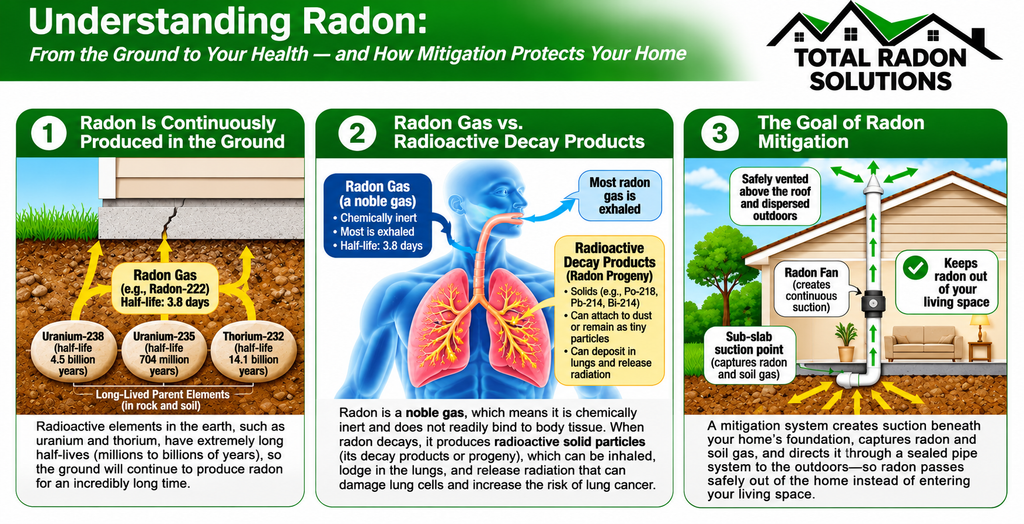
Radon is produced naturally through the radioactive decay of uranium and other radioactive elements found in rocks and soil.
Some of these elements have extraordinarily long half-lives. A half-life is the amount of time required for half the radioactive atoms in a sample to decay.
For example, uranium-238, which begins the radioactive decay chain that eventually produces radon-222, has a half-life of approximately 4.5 billion years. Other naturally occurring radioactive elements, including uranium-235 and thorium-232, also have half-lives measured in millions or billions of years.
Because these elements decay so slowly, the ground continues to produce radon over extremely long periods.
We cannot prevent the earth from producing radon. But we can prevent much of that radon from entering our homes.
Radon Is a Noble Gas — What Does That Mean?
Radon belongs to a family of chemical elements known as noble gases. These gases are chemically inert, meaning they generally do not react with other substances or form chemical bonds.
Because of this characteristic, radon gas does not readily attach itself to tissues inside our bodies.
The most common form of indoor radon, radon-222, has a half-life of approximately 3.8 days.
This is much longer than the time air typically remains in our lungs during normal breathing. As a result, most inhaled radon gas is exhaled before it undergoes radioactive decay.
However, being chemically inert does not mean radon is harmless. Radon is radioactive, and when it decays, it produces other radioactive elements with very different properties.
Radon Decay Products: The Greater Danger to Your Lungs
When radon gas undergoes radioactive decay, it produces radioactive solid elements known as radon decay products, sometimes called radon daughters or radon progeny.
These include radioactive isotopes of polonium, lead, and bismuth.
Unlike radon gas, these decay products are not chemically inert noble gases. They can attach to microscopic airborne particles, including dust and smoke, or remain suspended in the air as extremely small unattached particles.
When we breathe, some of these particles can become deposited in the airways and lungs.
As these particles continue to decay, they release radiation, particularly high-energy alpha particles, directly into nearby lung tissue.
Alpha particles cannot travel very far through matter. However, when radioactive particles are deposited inside the lungs, their radiation can reach surrounding cells and damage their DNA.
While our bodies can repair much of this damage, repeated radiation exposure increases the possibility that damaged cells will eventually develop into cancer.
It is primarily the radioactive decay products of radon, rather than the inhaled radon gas itself, that deliver the radiation dose responsible for radon’s lung cancer risk.
Why Do Radon Decay Products Break Down So Quickly?
Unlike the uranium that originally produces radon, many of the immediate radioactive decay products have very short half-lives.
For example:
- Polonium-218: Approximately 3 minutes
- Lead-214: Approximately 27 minutes
- Bismuth-214: Approximately 20 minutes
- Polonium-214: Less than one-thousandth of a second
Some later decay products have longer half-lives, such as lead-210 at approximately 22 years.
The short half-lives of the early decay products are especially important because these particles can release radiation shortly after becoming deposited in the respiratory tract.
The concern is not simply that radioactive particles enter the lungs. It is that radiation released by those particles can damage sensitive lung tissue.
If the Solid Particles Are the Danger, Why Do We Test for Radon Gas?
This is an important question.
Although radon decay products account for most of the radiation dose to the lungs, radon gas is the source of those radioactive particles.
As radon enters a home and accumulates, it continually undergoes radioactive decay, creating new radioactive particles in the indoor air.
Standard residential radon tests measure the concentration of radon gas. These measurements provide an established and practical way to evaluate exposure and determine whether mitigation is recommended.
Reducing the amount of radon gas entering a home also reduces the source of the radioactive decay products.
That is why testing for radon gas remains essential to protecting your family’s health.
Can Radon Cause Lung Cancer in Nonsmokers?
Yes. Radon exposure can cause lung cancer in people who have never smoked. According to the U.S. Environmental Protection Agency (EPA), radon is the leading cause of lung cancer among nonsmokers.
Although smoking greatly increases the risk associated with radon exposure, nonsmokers are not immune. Breathing elevated levels of radon over many years can damage lung cells and increase the likelihood of developing lung cancer.
One of the greatest concerns with radon is that exposure produces no immediate warning signs. People can live in homes with elevated radon levels for years without knowing it. The only way to determine whether your home has elevated radon levels is through testing.
Fortunately, radon testing is simple, and effective mitigation systems can significantly reduce elevated levels. Understanding your home’s radon levels allows you to make informed decisions about protecting your family’s long-term health.
How Does Long-Term Radon Exposure Affect Your Risk?
Radon-related lung cancer risk depends on both the concentration of radon in the air and how long a person is exposed. Generally, higher radon levels and longer periods of exposure increase the risk of developing lung cancer.
Radon exposure does not typically cause immediate symptoms. Instead, damage to lung cells can accumulate over many years, and lung cancer may not develop until long after exposure began. This is why living in a home with elevated radon levels for an extended period is a concern, even when everyone in the household feels healthy.
Because radon levels can change with seasons, weather conditions, and how a home is operated, periodic testing is important. Identifying elevated levels early and taking appropriate steps to reduce them can help lower long-term exposure and associated health risks.
Are children more vulnerable to radon exposure?
Children can be exposed to radon just like adults, and there are reasons to pay particular attention to their long-term exposure. Children generally breathe faster and have smaller, developing lungs, which may result in higher radiation doses from radon exposure compared with adults breathing the same air.
However, researchers have not conclusively established that children are more likely than adults to develop lung cancer from the same radon exposure. What we do know is that radon exposure contributes to long-term lung cancer risk, and reducing unnecessary exposure is beneficial for the entire family.
Because children may spend many years growing up in the same home, testing for radon is a sensible precaution. Identifying elevated levels and correcting them can help protect everyone who lives there, now and in the future.
Is Radon Linked to Other Types of Cancer?
Lung cancer is the only cancer conclusively established to be caused by inhaled radon, but researchers are investigating possible connections to other cancers, including leukemia and lymphoma.
Some studies have identified associations between residential radon exposure and certain blood cancers. Research has suggested possible increased risks among women and children, although findings have been inconsistent and researchers have not established a cause-and-effect relationship.
These findings are an important area of ongoing research, but they should not be interpreted as proof that radon causes blood cancers. At Total Radon Solutions, we believe homeowners deserve access to emerging scientific information while clearly understanding the difference between established health risks and possible associations still being studied.
Research: Residential Radon Exposure and Blood Cancer Risk in Women (2016)
Research: Residential Radon Exposure and Childhood Cancer Risk (2024)
How Can You Reduce Your Family’s Radon Exposure?
The first step in reducing radon exposure is knowing your home’s radon level. Because radon cannot be seen, smelled, or tasted, testing is the only reliable way to determine whether elevated levels are present.
Our Goal: Stop Radon Before It Enters Your Home
The earth will continue producing radon for an extraordinarily long time. We cannot eliminate the radioactive elements in the ground, but we can significantly reduce the amount of radon that enters your home.
At Total Radon Solutions, our goal is simple: Keep radon from ever becoming part of the air your family breathes.
Our mitigation systems are designed to create suction beneath your home’s foundation, drawing radon-containing soil gas into a collection point and directing it through sealed piping to a safe discharge location outdoors, typically above the roof.
Instead of allowing that soil gas to enter your living space, the system provides a controlled path for it to travel outside, where it can disperse into the atmosphere.
Because radon is continually produced underground, the mitigation system operates continuously to help prevent radon from accumulating indoors.
After installation, follow-up testing confirms how effectively the system has reduced indoor radon concentrations.
At Total Radon Solutions, we provide FREE radon testing throughout Utah and no-obligation mitigation estimates when elevated levels are discovered.
We’ll explain your test results, answer your questions, and discuss the mitigation options appropriate for your home.
We can’t stop the earth from producing radon. But we can help keep it out of your home.