
Marie Curie and Your Radon Test: The Story Behind pCi/L
What does Marie Curie have to do with your radon test? The connection is in the measurement: picocuries per liter, written as pCi/L. The curie is a unit of radioactivity whose name honors the Curie scientific legacy. Behind those letters is a remarkable story of discovery—and a connection between early radiation research and the equipment we use to measure radon in homes today.
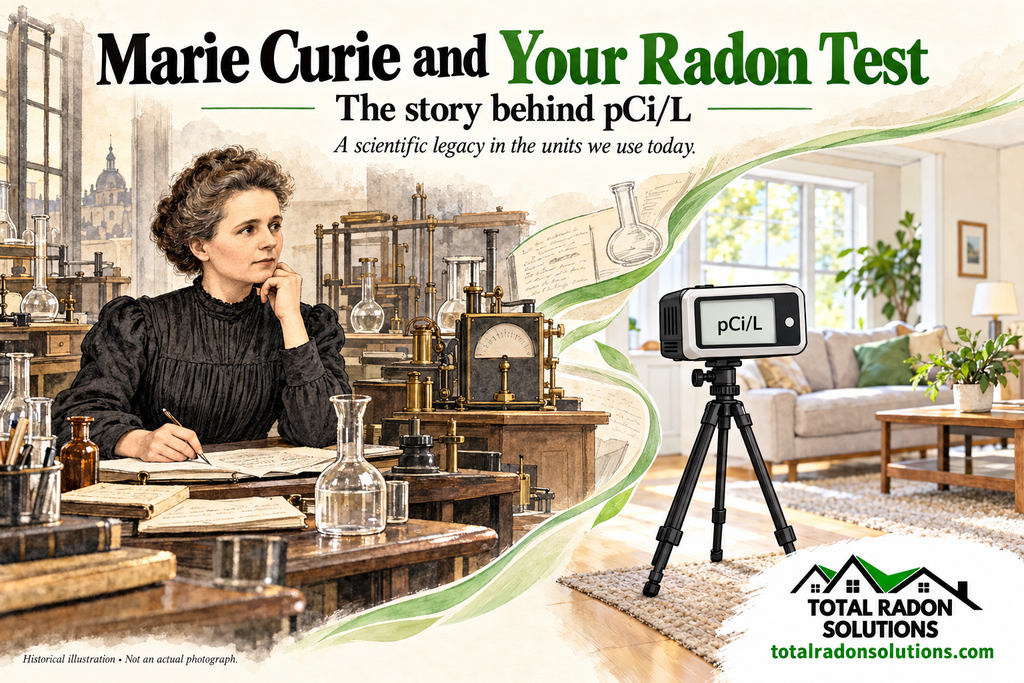
Table of Contents
Who Was Marie Curie?
Marie Skłodowska Curie was born in Warsaw in 1867 and later moved to Paris to study science. Her research helped transform our understanding of radioactivity. Working with her husband, Pierre Curie, she discovered polonium and radium in 1898.
In 1903, Marie and Pierre shared the Nobel Prize in Physics with Henri Becquerel for their research into radiation. Marie became the first woman to receive a Nobel Prize. In 1911, she received a second Nobel Prize, this time in Chemistry, for her work on radium and polonium.
Her work helped establish ways to study and measure radioactive materials. That scientific legacy connects her laboratory research to a familiar detail on modern radon reports: the curie in picocuries per liter.
What Does pCi/L Mean on a Radon Test?
In the United States, radon test results are commonly reported in picocuries per liter, abbreviated pCi/L. This measures the concentration of radioactivity from radon in the air.
A curie is a unit of radioactive activity. A picocurie is one trillionth of a curie, and “per liter” identifies the volume of air being measured. A higher pCi/L reading means a higher concentration of radon activity in that air.
The name connects your test report to the Curie family. NIST’s historical account explains that the unit was originally named in memory of Pierre Curie, with Marie Curie participating in the work to establish the standard. Today, the name is widely associated with their shared scientific legacy.
You do not need to calculate radioactive decay to understand your report. What matters is the measured radon level, the conditions and duration of the test, and what the results mean for your next steps.
Why 2.7? The WHO Radon Reference Level
You may have seen the World Health Organization’s radon reference level expressed as 2.7 pCi/L and wondered: why that particular number? It looks much simpler in the international measurement system—100 becquerels per cubic meter, written as Bq/m³. Converting that round number to picocuries per liter gives approximately 2.7 pCi/L.
Like inches and centimeters, these are two ways to express the same measurement: U.S. radon reports typically use pCi/L, while many other countries use Bq/m³.
There is another historical connection here. The becquerel is named after Henri Becquerel, who shared the 1903 Nobel Prize in Physics with Marie and Pierre Curie. The units on modern radon reports connect us to these early pioneers of radiation research.
The WHO recommends that countries establish an annual-average residential reference level of 100 Bq/m³ where achievable. In the United States, the EPA recommends fixing homes at 4.0 pCi/L or higher and considering reduction between 2.0 and 4.0 pCi/L. These are different recommendations as well as different ways of expressing measurements; neither number marks a boundary between risk and no risk.
Discovery Before the Risks Were Understood
Marie Curie worked with radioactive materials at a time when their health effects were not fully understood and modern radiation protections did not exist. She died in 1934 of aplastic anemia, a serious blood disorder widely attributed to her years of radiation exposure.
Her story shows how scientific discovery and knowledge about protection developed together. Today, we can measure radiation that our senses cannot detect and take practical steps to reduce unnecessary exposure.
For homeowners, that lesson connects directly to radon. You cannot see or smell it, but a radon test can measure it. If levels are elevated, mitigation can reduce them.
An Unusual Detail About Her Burial
Marie Curie’s story includes a remarkable detail that came to light when her remains were moved to the Panthéon in Paris in 1995. Inside her outer wooden coffin, workers found an intact lead coffin approximately 2.5 millimeters thick.
Radiation specialists monitored the transfer, measuring radiation levels and checking air samples and surfaces. Their findings add important context to the often-retold story: the monitoring confirmed no radiological risk to the workers, public, or environment.
The account brings together two parts of her legacy—the extraordinary discoveries of early radiation science and the careful measurement used to understand and manage exposure.
Read the historical account of the Curies’ 1995 transfer to the Panthéon.
From Scientific Discovery to Your Home
The history is fascinating, but the practical takeaway is simple: radon can be measured, and elevated levels can be reduced. Your test report uses the language of radiation science to answer a question that matters today—how much radon is in your home?
At Total Radon Solutions, we help Utah homeowners test for radon, understand their results, and explore mitigation options without sales pressure. We provide free radon testing and explain what the numbers mean so you can make an informed decision.