Table of Contents
How Do You Understand Your Radon Test Results?
Receiving your radon test results is an important step toward understanding the air quality in your home. But what do the numbers actually mean, and how do you know whether further action is needed?
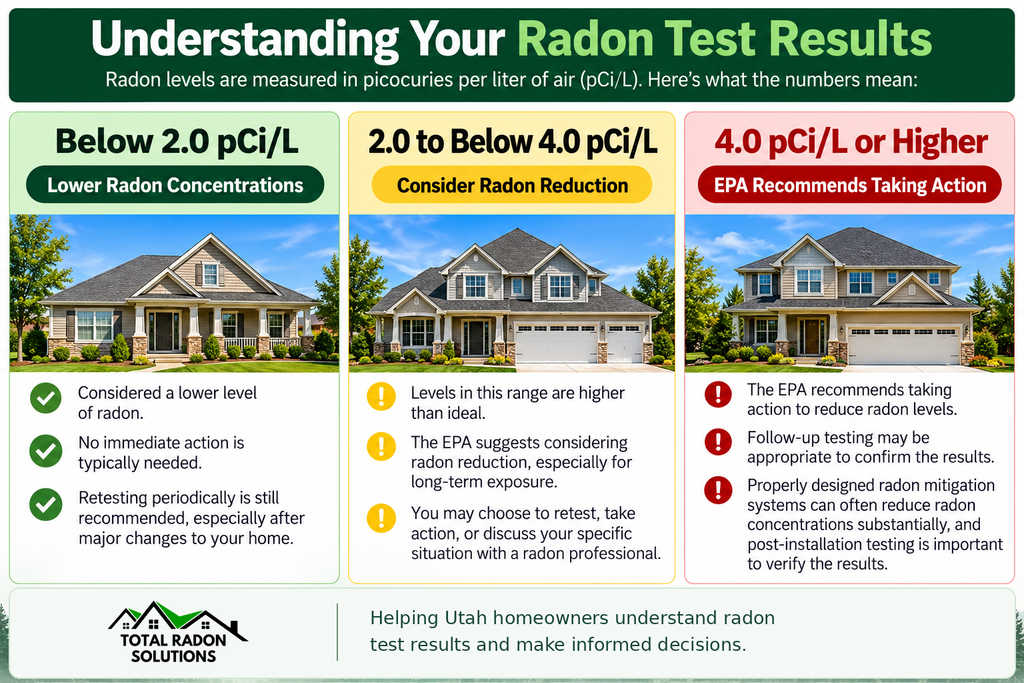
Radon concentrations are measured in picocuries per liter (pCi/L). The Environmental Protection Agency (EPA) recommends taking action when radon levels reach 4.0 pCi/L or higher and considering reduction when levels are between 2.0 and 4.0 pCi/L. Understanding these recommendations can help you make an informed decision about your home.
At Total Radon Solutions, we help Utah homeowners, buyers, and sellers interpret their test results, understand when additional testing may be appropriate, and explore mitigation options when needed. Our goal is to provide clear information and practical recommendations without unnecessary sales pressure.
What Do Different Radon Levels Mean?
Below 2.0 pCi/L — Lower Radon Concentrations
Radon readings below 2.0 pCi/L are generally considered relatively low. No level of radon exposure is completely risk-free, but these readings are below the EPA’s recommended range for considering mitigation. Homeowners should still retest periodically, especially after major renovations or changes to their home’s ventilation.
2.0 to Below 4.0 pCi/L — Consider Radon Reduction
The EPA recommends considering mitigation when radon concentrations fall between 2.0 and 4.0 pCi/L. Although these readings are below the EPA’s 4.0 pCi/L action level, they still represent some exposure risk. The World Health Organization recommends a reference level of 100 Bq/m³, approximately 2.7 pCi/L, where achievable. Homeowners can consider their circumstances, testing history, and preferences when deciding whether to take further action.
4.0 pCi/L or Higher — EPA Recommended Action Level
The EPA recommends taking action to reduce radon concentrations when results are 4.0 pCi/L or higher. Depending on the testing situation, follow-up testing may be appropriate to confirm the findings. Properly designed radon mitigation systems can often reduce concentrations substantially, and post-installation testing is important to verify the results.
The EPA’s action level is a guideline for deciding when to reduce radon, not a guarantee that lower levels are safe. At Total Radon Solutions, we explain the findings and available options so homeowners can make informed decisions without sales pressure.
How Do You Read a Professional Radon Test Report?
The reports generated by professional continuous radon monitors (CRMs) provide more information than a single radon measurement. Understanding the main parts of the report can help homeowners, buyers, and sellers evaluate their results with confidence.
Average Radon Concentration
The overall average radon concentration, expressed in picocuries per liter (pCi/L), is generally the primary result used to evaluate a properly conducted short-term test. This number represents the average concentration measured during the valid testing period. It is typically compared with the EPA’s recommended action level of 4.0 pCi/L.
Hourly Radon Readings
Continuous radon monitors record measurements at regular intervals, often hourly. These readings may be displayed in a graph or table, showing how radon concentrations changed throughout the test. It is normal to see peaks and valleys rather than a perfectly steady line. An individual high reading should be considered in the context of the complete test rather than treated as the overall result.
Temperature, Humidity, and Possible Interference
Depending on the equipment, professional radon reports may include temperature and humidity measurements, movement indicators, or other information that helps evaluate testing conditions. At Total Radon Solutions, both types of continuous radon monitors we use have features that help identify possible movement and changes in environmental conditions. Unusual changes may warrant further review, but they do not automatically establish that someone intentionally interfered with the test.
Testing Dates and Conditions
A professional report should identify when the test was performed, its duration, and relevant information about the testing conditions. Proper equipment placement and closed-house conditions are particularly important during 48-hour real estate tests. If required conditions were not maintained, additional testing may be necessary to obtain reliable results.
At Total Radon Solutions, we review the information collected during testing and help customers understand both the average result and any unusual patterns that may require attention. Our goal is to provide useful information, not simply hand over a report filled with numbers.
When Should You Retest Your Home for Radon?
After an Elevated Initial Test
If an initial radon test shows elevated levels, additional testing may help confirm the results and guide the next steps. For homeowners who are not facing an immediate deadline, a second short-term test or a long-term test may provide additional information. Higher initial readings call for more prompt follow-up.
During real estate transactions, the procedures can differ. A properly conducted 48-hour test using a professional continuous radon monitor can provide a basis for deciding whether mitigation is needed without requiring a second test. Buyers and sellers should also consider their contract deadlines and any lender requirements.
After Radon Mitigation
Every radon mitigation installation should be followed by testing to verify that the system is effectively reducing radon levels. At Total Radon Solutions, we provide this follow-up testing as part of our installation process and encourage independent third-party verification as well.
If the results do not meet our reduction target, we investigate further and make appropriate adjustments. We may monitor different areas of the home over an extended period before recommending changes to fan capacity or other system components.
Even after successful mitigation, the EPA recommends retesting at least every two years to confirm that radon concentrations remain low. Homeowners should also periodically check that their mitigation system is operating properly.
After Renovations or Changes to the Home
Major renovations, foundation modifications, basement finishing, additions, and changes to heating or ventilation can affect radon concentrations. Testing after these changes helps determine whether the home’s radon levels have changed.
Retesting is particularly important if you begin using a previously unoccupied basement or lower level as regular living space, such as a bedroom or home office.
When Previous Test Results Are Old or Conditions Have Changed
A radon test provides information about the conditions during the period when it was performed. Because radon concentrations can change over time, an older test may not fully represent current conditions. Retesting can be especially useful before selling or purchasing a home or when earlier results were obtained under unusual ventilation or seasonal conditions.
At Total Radon Solutions, we help homeowners understand when another test would provide useful information and when the existing results are sufficient to make an informed decision. Our approach is to recommend testing and mitigation based on the circumstances of the home, not unnecessary repeat visits or equipment.
Have Questions About Your Radon Test Results?
Understanding your radon test results is the first step toward protecting your home and family. At Total Radon Solutions, we’re happy to help Utah homeowners understand their results, answer questions, and explain their options. Whether your radon level is slightly elevated or significantly above the EPA action level, we’ll provide straightforward information without pressure or obligation. We offer free radon testing throughout Utah and free mitigation estimates when needed.