What Is Radon and Why Should Utah Homeowners Care?
Radon is a naturally occurring radioactive gas produced by the breakdown of uranium in soil and rock. It’s invisible, odorless, and tasteless, so there’s no way to detect it without testing. Radon can enter homes through cracks and openings in the foundation, where it may accumulate to unhealthy levels. Because uranium occurs naturally in Utah’s geology, radon is a concern for homeowners throughout the state. The good news is that testing is simple, and elevated radon levels can be reduced with a properly designed mitigation system.
For another explanation of what radon is and where it comes from, visit the U.S. Environmental Protection Agency’s radon information page.
Table of Contents
How Does Radon Enter Your Home?
Radon gas moves naturally through the soil and can enter your home through cracks in concrete floors, foundation walls, construction joints, gaps around plumbing pipes, sump pits, and other openings. Differences in air pressure between the soil and the inside of your home can actually draw radon gas indoors. Once inside, radon can accumulate, particularly in basements and other areas that are in contact with the ground. Even newer homes with well-sealed foundations can have elevated radon levels, which is why testing is important regardless of your home’s age or construction.
Why Can Neighboring Homes Have Different Radon Levels?
Radon levels can vary dramatically between neighboring homes—even houses built by the same contractor in the same subdivision. Differences in soil composition, foundation construction, ventilation, and air pressure can all affect how much radon enters a home. One house may have low radon levels while the home next door has elevated levels. That’s why you cannot rely on a neighbor’s test results or a neighborhood radon map to determine whether your own home is safe. The only reliable way to know your home’s radon level is to test it.
What Radon Level Is Considered Unsafe?
Radon is measured in picocuries per liter of air (pCi/L). The U.S. Environmental Protection Agency (EPA) recommends taking action to reduce radon levels at 4.0 pCi/L or higher. The EPA also recommends considering mitigation when levels are between 2.0 and 4.0 pCi/L.
The World Health Organization (WHO) recommends that countries establish a residential radon reference level of 2.7 pCi/L (100 Bq/m³), where achievable. This reflects the understanding that radon exposure carries some risk even below the EPA’s action level.
At Total Radon Solutions, we generally use the EPA’s 4.0 pCi/L action level when recommending mitigation, but we also educate homeowners about the WHO’s lower reference level and the potential risks of long-term radon exposure. Our goal is to provide clear information so you can make an informed decision about your home without sales pressure.
How Can You Test Your Home for Radon?
Testing is the only way to know whether your home has elevated radon levels. Two common testing methods are continuous radon monitors (CRMs), which electronically measure radon levels over time, and charcoal test kits, which collect a sample that is analyzed by a laboratory.
At Total Radon Solutions, we offer FREE radon testing to homeowners throughout Utah. For homes within approximately 75 miles of Ephraim, we typically use professional continuous radon monitors. For homeowners farther away, we can mail a charcoal test kit with instructions for completing the test.
Whichever testing method you use, proper placement and following the test instructions are essential for obtaining meaningful results. We’ll help you understand your results, answer your questions, and explain your options without pressure or obligation.
The Radiation Alarm That Led Investigators Home
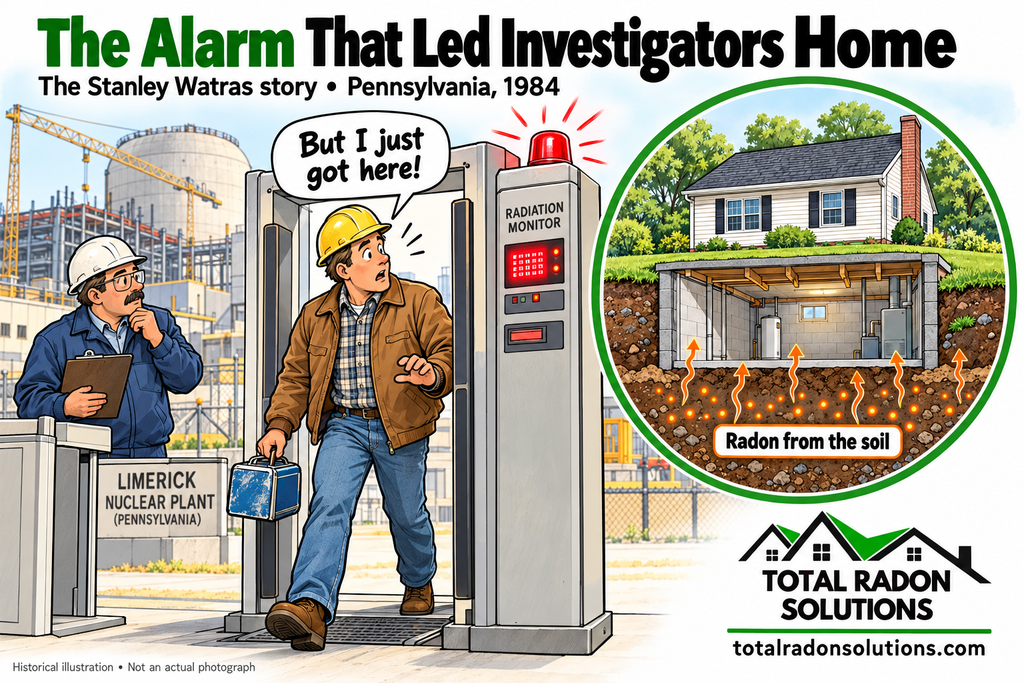
In 1984, Stanley Watras triggered a radiation monitor when he arrived for work at Pennsylvania’s Limerick nuclear power plant. The surprising part: the plant was still under construction, and nuclear fuel had not yet arrived. The investigation led to his home, where testing revealed extremely high levels of radon (2700 pCi/L).
The incident helped bring national attention to radon in homes. More than four decades later, we still regularly meet Utah homeowners—and builders—who are unfamiliar with it. His story illustrates why testing matters: a home can have elevated radon without any noticeable smell or other obvious warning.
Today, homeowners can test existing homes and plan for radon systems during new construction. Early planning gives builders more options to incorporate collection areas and discreet piping routes before walls and finishes are installed.
Read the original account in the August 1986 EPA Journal.
Can Radon Be Reduced in Your Home?
Yes! Elevated radon levels can be reduced with a properly designed and installed radon mitigation system. Most residential systems use a specialized fan and piping to draw radon-bearing soil gas from beneath the foundation and safely discharge it outdoors, above the roofline, before it can enter the living space.
At Total Radon Solutions, we evaluate each home’s construction and conditions to design an effective system. Whenever practical, we prefer discreet interior installations and work to achieve successful radon reduction with a single system. After installation, follow-up testing is essential to confirm that radon levels have been reduced.
If your home has elevated radon levels, we’ll explain your options and provide a FREE, no-obligation mitigation estimate. Our goal is to help you make an informed decision without unnecessary pressure.